


We Sent Our Fabrics to TÜV SÜD. 54 Substances. Zero Detected. Here's What That Means for Your Brand — and Why the Conversation Has Changed.
For outdoor apparel sourcing managers, performance wear fabric buyers, sustainable fashion product developers, and technical textile designers working through an industry in transition.
Julia W
5/29/20267 min read
The Claim Everyone Is Making. The Document Few Can Produce.
Walk through any major outdoor apparel trade show today and you'll hear it from nearly every supplier booth:
"Our fabric is PFAS-free."
It's become a marketing phrase. A checkbox. A line on a sell sheet that buyers are expected to accept at face value.
The problem is that PFAS — per- and polyfluoroalkyl substances — are a family of thousands of individual chemical compounds. Saying a fabric is "PFAS-free" without third-party testing documentation is a statement that cannot be verified, and in an increasing number of sourcing contexts, cannot be used in commercial claims without substantiation.
We understand the frustration. You're asking your suppliers for PFAS-free documentation. Some send a supplier declaration. Some send an internal quality statement. Some send nothing and ask you to trust the process.
At YUNLAN Textile, we sent our fabrics to TÜV SÜD.
Here's what came back.
The Test Report — What It Covers and What It Proves
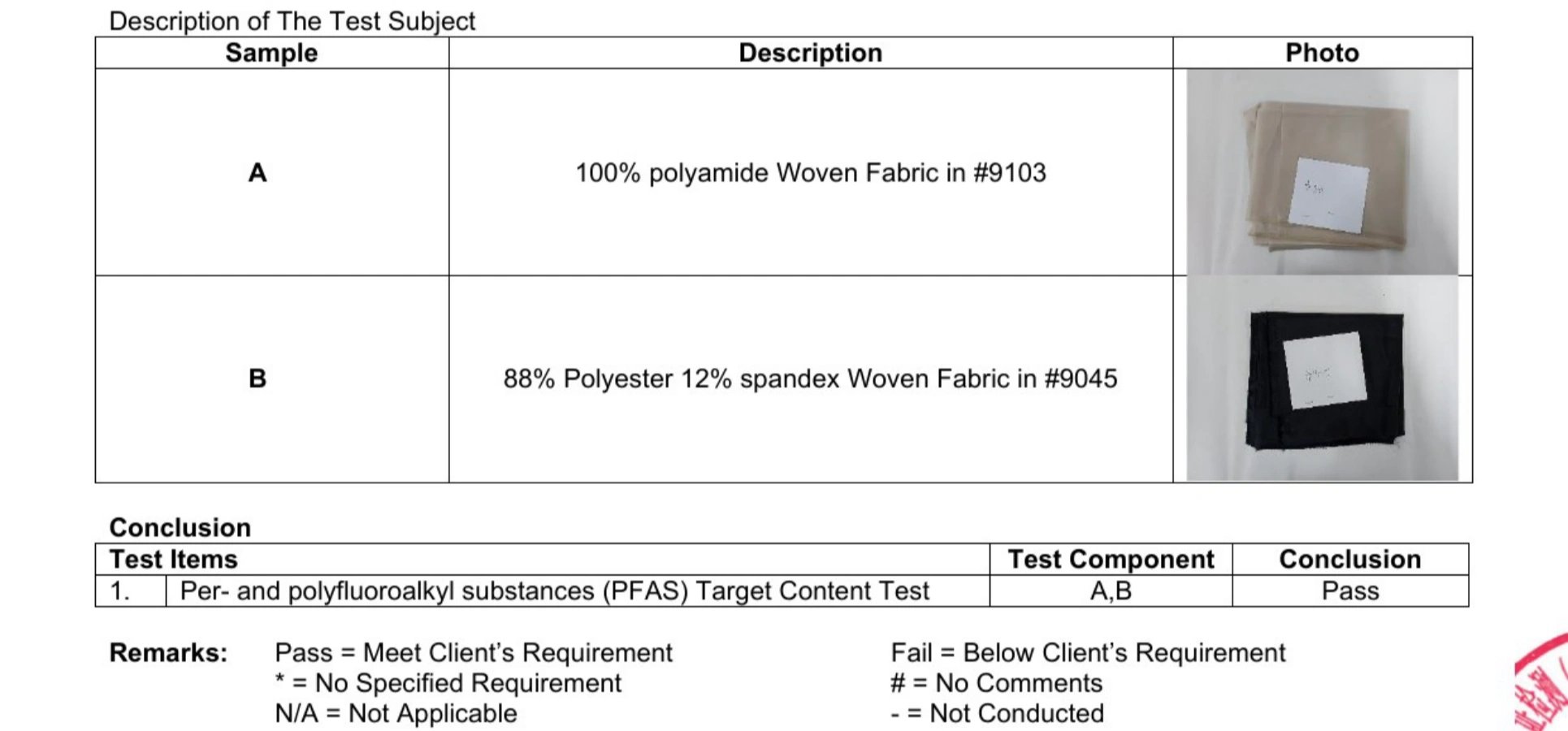
Two fabric samples were submitted to TÜV SÜD Certification and Testing (China) Co., Ltd., Ningbo Branch for independent PFAS analysis:
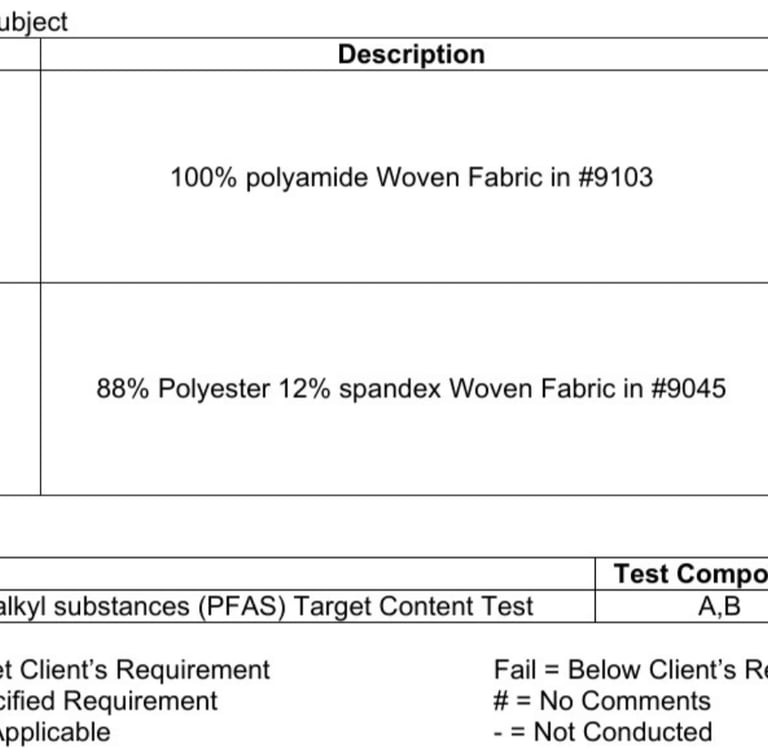
Sample A: 100% Polyamide Woven Fabric (#9103)
Sample B: 88% Polyester / 12% Spandex Woven Fabric (#9045)
The test was conducted with reference to EN 17681-1:2025 — the current European standard for PFAS testing in textiles — using LC-MS/MS (liquid chromatography–tandem mass spectrometry), an analytical method sensitive enough to detect compounds at the parts-per-billion level.
54 individual substances were screened, spanning the full breadth of known PFAS compound categories:
PFOS and its salts (including PFOS-K, PFOS-Li, PFOS-NH₄ variants)
PFOS-related substances (FOSA, N-MeFOSA, N-EtFOSA, N-MeFOSE, N-EtFOSE)
PFOA and its salts
PFOA-related substances (8:2 FTOH, 8:2 FTA, 8:2 FTMA, 8:2 FTS)
C9–C14 perfluoro carboxylic acids and salts
PFHxS and its salts
PFHxS-related and PFHxA-related substances
6:2 fluorotelomer series compounds
Conclusion across both samples: PASS.
Every substance across all 54 line items returned ND — Not Detected — meaning results fell below the Method Detection Limit. No PFAS compounds were present at measurable concentrations in either fabric.
This is not a supplier declaration. This is an instrument-verified result from one of the most recognized third-party testing bodies in the global textile industry.
Why This Conversation Has Shifted
PFAS have been central to durable water-repellent finishing in textiles for decades. The fluorinated chemistry delivered reliable water beading, stain resistance, and surface energy reduction. From a performance standpoint, it worked.
The shift happening across the industry isn't primarily regulatory. It's a quieter, more durable change in how brands, retailers, and consumers think about the materials they work with and wear.
Outdoor specialty retailers began asking their suppliers for chemical transparency before formal restrictions required it. Brands in the performance lifestyle and sustainable fashion space started including PFAS in their materials-sourcing criteria — not because a regulation forced them to, but because their customers started asking.
What's changed in the last two to three years is that this expectation has moved from the leading edge of the market toward the center. PFAS-free is increasingly treated as baseline sourcing practice across technical outdoor, performance activewear, and responsible apparel categories — the same way recycled fiber content or restricted substance list (RSL) compliance became standard expectations over the past decade.
For sourcing teams building collections for 2025 and beyond, the question has shifted from whether to eliminate PFAS from the supply chain to whether your suppliers can document that they already have.
Understanding C0 DWR — The Chemistry Behind the Certification
When a fabric is described as C0 DWR or fluorine-free DWR, it means the water-repellent finish uses no fluorinated chemistry — no C8 compounds, no C6 compounds, no PFAS of any category.
C0 finishes achieve surface moisture management through alternative polymer systems — wax-based, dendrimer-based, or bio-based chemistries — that create hydrophobic surface energy without persistent fluorinated compounds.
The performance outcome: water beads and rolls off the fabric surface. Light rain and environmental moisture are managed. The face fabric resists wet-out — the saturation of the outer layer that collapses breathability and adds weight to the garment.
The supply chain outcome: no persistent fluorinated chemistry in the production process, in the finished garment, or in the post-use waste stream.
And the test outcome: results like the ones in our TÜV SÜD report. 54 substances. All Not Detected.
For technical designers working on softshell jackets, hiking pants, and outdoor activewear, C0 DWR is now the standard formulation for collections built with responsible sourcing in mind.
The Two Fabrics in the Report — And What They're Built For
Sample A: 100% Polyamide Woven Fabric
Nylon — polyamide — is the fiber of choice for technical outdoor applications where abrasion resistance, tensile strength, and tear resistance are non-negotiable. Trail pants, shell jackets, and hardwear-adjacent apparel categories all lean on nylon's inherent durability.
The 100% polyamide construction here is a face fabric built for technical outerwear where the fiber's performance characteristics matter as much as the finishing chemistry. PFAS-free certification on a pure nylon woven substrate gives brands building outdoor shells and trail pants a solid foundation for their materials documentation.
Sourcing teams working on PFAS-free nylon woven fabric for outerwear, certified nylon fabric C0 DWR, or technical shell fabric supplier with test documentation will find this substrate directly relevant.
Sample B: 88% Polyester / 12% Spandex Woven Fabric
Polyester-spandex blends in a woven construction cover the broader activewear, athleisure, and performance lifestyle market — training wear, golf apparel, and active casual categories where stretch, color performance, and moisture management converge.
The 12% spandex component enables the 4-way stretch behavior that defines modern performance wovens. The polyester face takes dye reliably, holds color through wash cycles, and provides the clean surface needed for sublimation printing or solid-color dyeing.
For brands sourcing PFAS-free polyester spandex stretch fabric, 88 polyester 12 spandex woven activewear, or sustainable activewear fabric with documented testing — this is the substrate.
What Sourcing Teams Are Running Into
These are the patterns we hear consistently from product developers and buyers working through the PFAS transition:
"Our supplier says it's PFAS-free but can't send documentation." A verbal assurance or internal quality statement doesn't satisfy the sourcing briefs that retail partners, brand sustainability teams, or materials review processes are now running. Third-party test reports from accredited laboratories have become the working standard.
"We received a test report, but it only covered a few PFAS compounds." Selective PFAS screening — running three or four of the most commonly cited compounds and declaring the fabric clean — leaves exposure across the broader compound family. EN 17681-1:2025 covers 54 individual substances across all major PFAS categories. That's the scope the market is moving toward.
"We got a test report, but we don't recognize the lab." The accreditation behind the laboratory matters when the report needs to hold up in a supplier questionnaire or materials audit. TÜV SÜD carries established credibility across global textile sourcing contexts. The report does the work it's supposed to do.
"Every time we ask for updated documentation, there's a delay." Test reports should be part of the standard supplier package, available at the sampling stage — not a reactive response to buyer requests made weeks into the development process.
"The DWR performance didn't hold after washing." C0 DWR formulations vary in durability. Not all fluorine-free finishes perform equally across wash cycles. This is a legitimate technical concern worth raising at the sampling stage, where wash cycle performance data can be reviewed against your specific end-use requirements.
Working with YUNLAN Textile — What's Different in Practice
We're not going to claim a frictionless process. Supply chain work involves variables, and anyone who promises otherwise is describing something other than manufacturing.
What we can describe is how we approach the documentation and communication side of sourcing:
Test reports are part of the package. Our TÜV SÜD PFAS documentation is available during the sampling discussion — not something you need to request separately after three weeks.
The compound scope is complete. 54 substances per EN 17681-1:2025. Not a selective screen. The range that materials review processes at responsible brands are now expecting.
Specifications are provided upfront. Fiber composition, GSM, stretch behavior, DWR chemistry type, available colorways, and finish options — given clearly before you commit to sampling. Fewer surprises in the lab test results.
Sample-to-bulk consistency is managed, not assumed. Finishing parameters are standardized. Color runs through a lab dip approval process. The fabric you approve is the fabric that goes into production.
Pricing doesn't shift after you've committed. Standard specifications — including C0 DWR finishing — are priced into the initial quote. The invoice reflects what was agreed.
Technical questions get technical answers. Questions about chemical finishing, fiber certification, or test methodology are answered by people who understand the fabric. Not passed through a sales layer.
Frequently Asked Questions
Q: What is the full scope of your PFAS test report? A: The TÜV SÜD report covers 54 individual PFAS substances across all major compound categories — PFOS, PFOA, PFHxS, PFHxA, C9-C14 perfluoro carboxylic acids, and related substances — tested per EN 17681-1:2025 using LC-MS/MS. Both Sample A (100% polyamide) and Sample B (88% polyester / 12% spandex) returned Not Detected across all 54 line items.
Q: Which laboratory conducted the testing? A: TÜV SÜD Certification and Testing (China) Co., Ltd., Ningbo Branch — Softlines Laboratory. The report number and date are available upon sourcing discussion.
Q: Can I receive a copy of the report for my materials documentation? A: Yes. The report is available as part of the sampling process. Reach out with your project brief and we'll confirm what's available for the specific fabric you're looking at.
Q: Does C0 DWR mean the fabric is waterproof? A: No — and this is worth being clear about. C0 DWR is a surface treatment that causes water to bead and roll off the fabric face, managing light rain and incidental moisture. Full waterproofing requires a laminated membrane with sealed seams. DWR alone — fluorinated or fluorine-free — does not make a fabric waterproof.
Q: How does C0 DWR hold up across wash cycles? A: Performance varies by chemistry formulation and application method. If your end-use has specific wash durability thresholds — based on ISO 105-C06, AATCC 61, or equivalent — raise these at the sampling stage. We can provide wash cycle performance guidance for the specific application.
Q: Are these fabrics compatible with bluesign® or OEKO-TEX sourcing frameworks? A: The TÜV SÜD PFAS documentation addresses the chemical safety component of broader sustainability certification programs. For full framework alignment — bluesign®, OEKO-TEX STANDARD 100, or others — discuss your specific program requirements with us. Compatibility varies by certification scope and production volume.
Q: What are the MOQ requirements? A: MOQ is discussed based on the specific fabric, colorway, and production parameters of your project. We work with brands across different volume tiers and prefer to have that conversation around your actual brief rather than a blanket number.
In Brief
Two fabrics. One testing standard. 54 substances. Both samples passed.
The TÜV SÜD report exists, it's instrument-verified, and it's available when you need it for your sourcing process.
If you're developing a technical outdoor, performance activewear, or responsible apparel collection and want to work with a supplier who has the documentation ready — reach out.
Connect With Us
📌 LinkedIn: https://www.linkedin.com/in/ylfabric/
📦 Technical outdoor fabric range: https://www.yl-fabric.com/yl2429-technical-outdoor-apparel-blueprints
YUNLAN Textile — Functional & Woven Fabric Supplier
#PFASFree #SustainableTextiles #OutdoorApparel #FabricSourcing #ResponsibleSourcing
Address
Office Hours
YL Textile
No. 999 Xihuan 2nd Rd.,
Shengze Town, Wujiang Dist.,
Suzhou, Jiangsu, China
Postal Code: 215228
Contact
Mon - Fri: 09:00 - 22:00
Sun: Closed