




From Greige to Garment: The Journey of a Fabric — Part 1: Lab Dips (L/D)
With 24 years in the textile industry, I've seen more orders derailed by color approval than almost anything else — missed deadlines, endless resubmissions, frustrated clients. Over the next 1–2 weeks, I'll be publishing one in-depth post per day walking through the complete fabric development process, from greige goods all the way to finished garment. No textbook theory — just real-world production knowledge, including the pain points that cost factories and supply chains time and money, and how we solve them.
Julia W
6/3/20262 min read
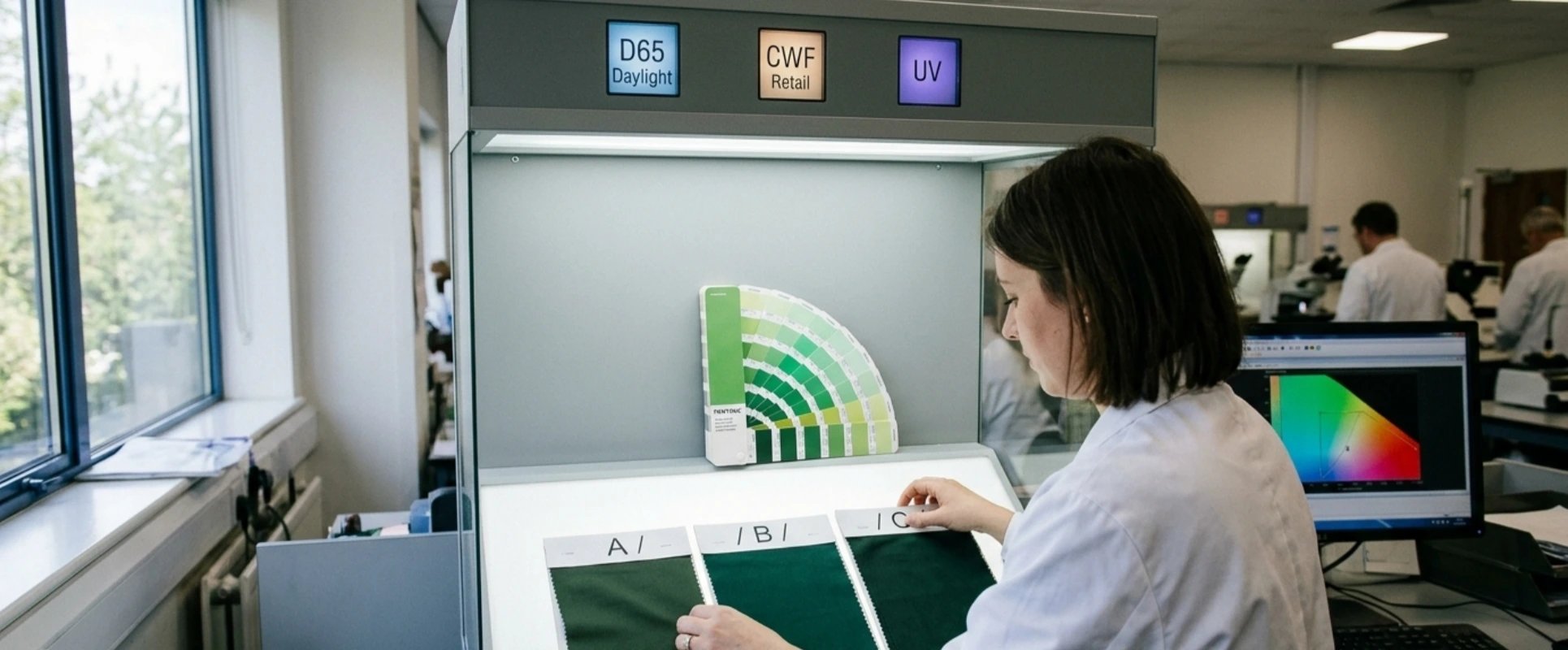
First stop: Lab Dips
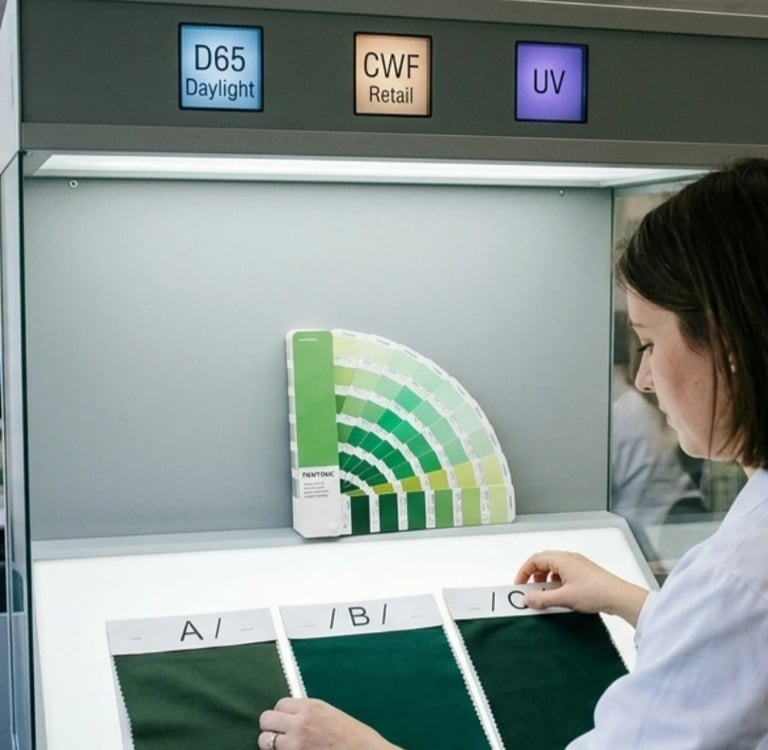
Once an order is confirmed, the buyer submits either a physical color standard or a Pantone reference. From there, our dyehouse develops a lab dip (L/D) — typically presented as three options (A / B / C), each with a slight colorimetric shift, giving the buyer a workable range for approval.
Simple in principle. In practice, this is where things quietly go wrong.
❓ Pain point #1: The lab dip looks spot-on in our facility — but the buyer rejects it outright. Why?
Two root causes:
① Metamerism / light source mismatch If your team is evaluating color under standard office fluorescent lighting while the buyer is using a D65 daylight simulator — or the retailer is assessing under TL84 (the standard for European retail environments) — you're not comparing the same color. Metamerism will make identical dye formulations look dramatically different under different illuminants.
② Warp vs. weft directionality Woven fabrics reflect light differently depending on orientation. If the buyer doesn't align the swatch to the correct grain direction, they may be assessing the weft face against your warp-face reference — an easy source of perceived color shift.
✅ Our approach: We confirm the buyer's evaluation light source before the first dyehouse submission. One conversation at the start eliminates days of unnecessary iteration.
❓ Pain point #2: The buyer asks to develop off Option B — "add a red cast, push the depth." Now what?
The dyehouse develops a new A/B/C round on top of the B base, and the lab dip cycle restarts. This is completely normal — but it's where internal version control breaks down.
Mixing up Round 1 and Round 2 submissions is more common than it should be. Once the buyer references the wrong generation, color direction drifts and the entire approval timeline compounds.
✅ Our approach: Every submission is logged with a unique batch number, submission date, and round reference. A traceable lab dip archive is non-negotiable.
❓ Pain point #3: Why does the price change between initial quote and color development?
This is a common friction point between buyers and mills — and it's worth explaining clearly.
Certain shades, particularly deep blacks, navy depths, and high-saturation hues, require significantly higher dye liquor concentrations than anticipated at the RFQ stage. A standard black may quote at 1.0% shade depth; achieving the buyer's required depth may demand 1.5% or above. That's a direct cost impact on dyestuff, auxiliaries, and water consumption.
✅ Our approach: We flag high-risk colorways during the costing stage, not after the lab dip is returned. Transparency upfront protects both sides.
Once color is approved, the greige fabric is dispatched to the dyehouse for pre-treatment — scouring, desizing, and preparation for dyeing.
🔔 That's tomorrow's post. Follow me so you don't miss it.
If you work in garment manufacturing, fabric sourcing, supply chain, or product development — this series is built for you.
👉 Follow me or connect with me here on LinkedIn. And if this is relevant to someone on your team, tag them or share it forward — the more informed our industry is, the better we all work.
Looking for a reliable functional woven fabric partner? Explore our technical capabilities and running qualities: 🌐 https://www.linkedin.com/in/ylfabric/
#TextileIndustry #FabricDevelopment #ApparelManufacturing #SupplyChainManagement #GarmentProduction #FabricSourcing #ColorManagement #TextileTechnology #FashionSupplyChain #WovenFabrics
Address
Office Hours
YL Textile
No. 999 Xihuan 2nd Rd.,
Shengze Town, Wujiang Dist.,
Suzhou, Jiangsu, China
Postal Code: 215228
Contact
Mon - Fri: 09:00 - 22:00
Sun: Closed